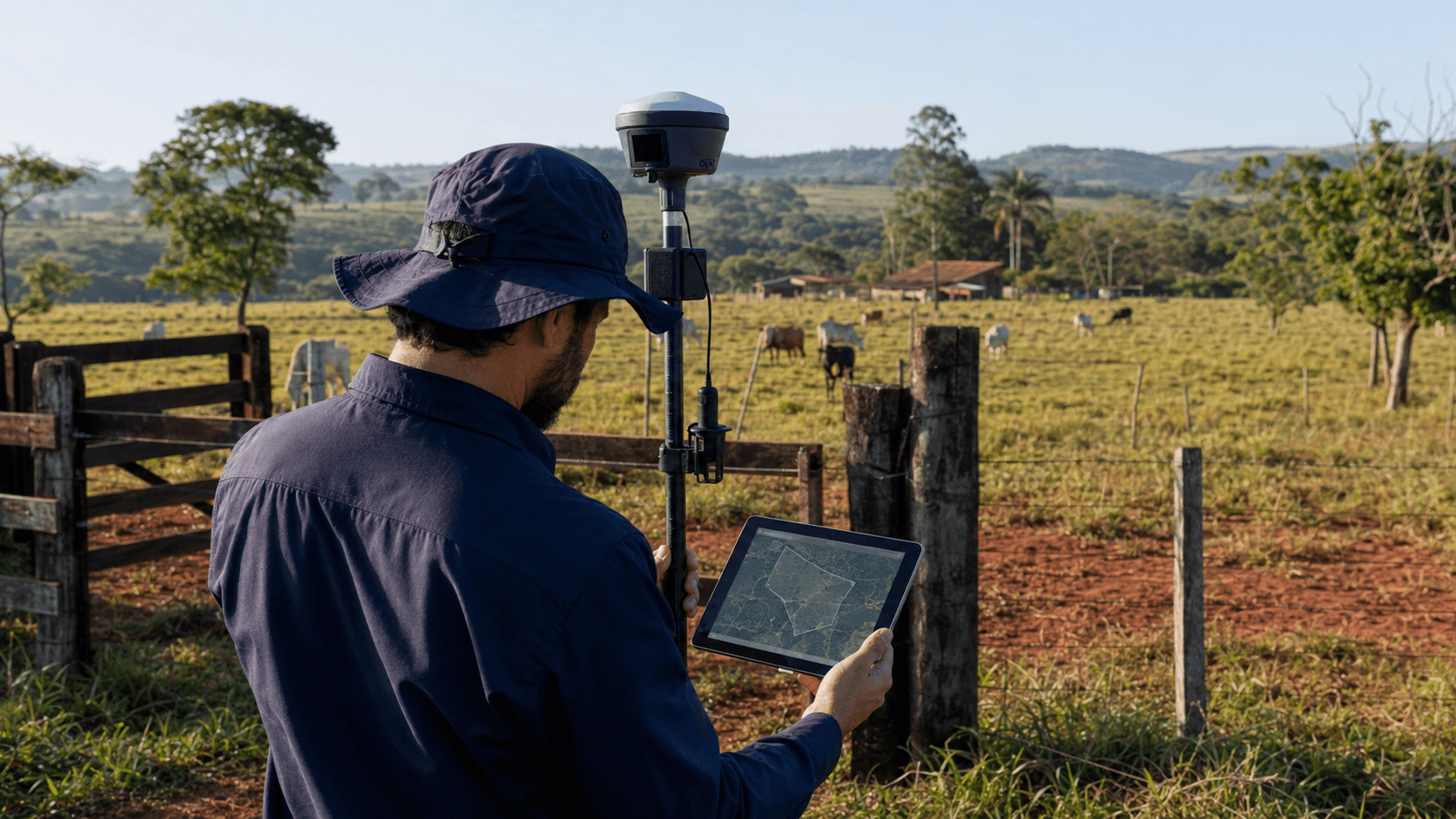
Assessing rural property in Brazil requires several documents and databases to be reviewed together.
Among the most important are the land registry record, known as the matrícula, the Rural Environmental Registry (CAR), and certified georeferencing (GEO).
They serve different purposes, and none provides a complete view of the property on its own.
Matrícula: the property’s legal registry record
The matrícula is the official record maintained by the competent Real Estate Registry Office.
It may contain information regarding:
- identification of the property;
- registered ownership;
- history of transfers;
- registered description of the land;
- mortgages;
- attachments;
- usufruct rights;
- easements;
- restrictions;
- other registered liens or encumbrances.
Reviewing the matrícula helps establish whether the seller is the registered owner and whether any recorded restrictions may affect the transfer or use of the property.
The matrícula should be current
An older copy may not show subsequent registrations.
The review should therefore use a recently issued registry certificate.
Earlier registry records, supporting deeds and additional certificates may also need to be examined.
Chain of title
The chain of title is the historical sequence of owners and transfers involving the property.
Its review may reveal:
- defects in previous transfers;
- inconsistencies in the land description;
- overlapping rights;
- missing documents;
- potential disputes;
- issues involving the origin of title.
The required scope depends on the history and characteristics of the property.
This review must be conducted by an appropriately qualified legal professional.
CAR: the environmental registry
The Rural Environmental Registry is a mandatory national electronic registry for rural properties.
It contains declared environmental information regarding the property or possession, including:
- declared perimeter;
- remaining native vegetation;
- Permanent Preservation Areas;
- Legal Reserve;
- consolidated-use areas;
- restricted-use areas.
CAR is relevant to environmental monitoring and regularization.
However, registration in CAR does not, by itself, prove legal ownership.
Registration does not necessarily mean final compliance
A CAR registration receipt does not necessarily mean that all submitted information has been reviewed or approved by the environmental authority.
The assessment should verify:
- registration status;
- whether an official review has occurred;
- notices or pending requirements;
- differences in area;
- overlaps;
- environmental liabilities;
- required corrections;
- regularization obligations.
The declared information should also be compared with the physical condition of the property.
GEO: technical definition of the perimeter
Georeferencing defines the property boundaries through coordinates linked to Brazil’s official geodetic system.
When certified through the applicable system, it helps confirm whether the submitted perimeter meets the technical requirements and whether conflicts have been identified with other certified perimeters.
The review should consider:
- measured area;
- boundary points;
- coordinates;
- neighboring properties;
- technical description;
- survey plan;
- professional responsibility;
- certification status.
Certification does not replace registration
Certified georeferencing provides a technical perimeter, but it does not replace the matrícula or transfer ownership.
To produce registry effects, the documents must be submitted to and accepted by the Real Estate Registry Office under the applicable requirements.
Differences may therefore exist between:
- the area recorded in the matrícula;
- the area declared in CAR;
- the area measured through georeferencing;
- the area physically occupied or used.
These differences should be understood before the acquisition.
The documents should describe the same property
The key task is not merely confirming that each document exists.
The information must be compared across all records.
The review should address:
- owner’s name;
- location;
- area;
- perimeter;
- adjoining properties;
- environmental areas;
- access;
- watercourses;
- occupation;
- overlaps;
- restrictions.
When the matrícula, CAR, GEO and physical condition do not correspond, the discrepancy should be investigated before any binding commitment is signed.
Other documents may also be required
Depending on the property, due diligence may include:
- CCIR rural property certificate;
- ITR rural property tax records;
- tax clearance certificates;
- environmental licenses;
- water-use permits;
- vegetation-clearing authorizations;
- lease agreements;
- easements;
- corporate documents;
- judicial or administrative proceedings;
- seller certificates.
The final document list should reflect the characteristics of the transaction.
Who should conduct the reviews
The documentary assessment may require:
- legal counsel;
- real estate registry specialists;
- land surveyors;
- forestry engineers;
- agronomists;
- environmental consultants;
- accountants;
- other licensed professionals.
The investor’s representative coordinates those specialists, compares their findings and consolidates separate technical reviews into a coherent view of the risk.
What the investor should receive
Before making a final decision, the investor should receive a report explaining:
- which documents were reviewed;
- which information was confirmed;
- which discrepancies were identified;
- which matters require correction;
- who will be responsible for each correction;
- which risks remain;
- whether the acquisition should proceed, proceed subject to conditions, or be rejected.
Conclusion
The matrícula, CAR and GEO are not interchangeable documents.
The matrícula reflects the registry status, CAR contains declared environmental information, and GEO technically defines the perimeter.
A secure acquisition depends on reviewing them together, comparing them with the physical property and engaging appropriately qualified professionals.
Related reading: How to Buy a Cattle Ranch in Brazil Safely
Related reading: Can Foreigners Own Rural Land in Brazil?