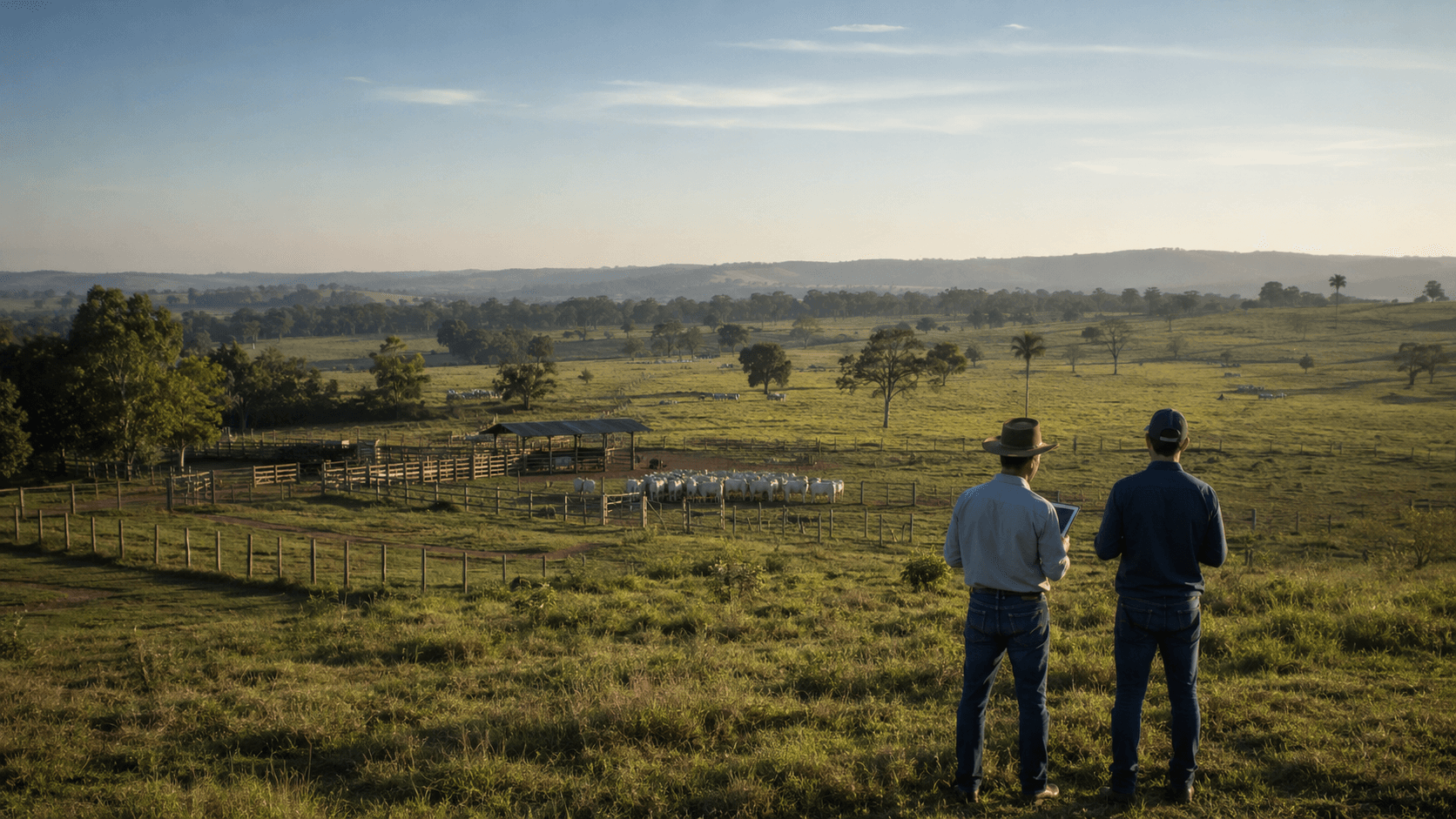
Buying a cattle ranch in Brazil can offer a compelling investment opportunity, but the outcome depends heavily on the discipline applied before the acquisition.
A rural property should not be selected solely because of its location, appearance or advertised price per hectare. Investors need to understand its productive potential, required capital improvements, legal and environmental risks, and its ability to support the intended investment strategy.
Begin with the investment objectives
The process should begin before the property search.
The investor should define:
- available capital;
- investment horizon;
- acceptable level of risk;
- intended production model;
- expected return;
- operational income requirements;
- eventual exit strategy.
Together, these elements form the investment mandate.
Without a clear mandate, very different properties may appear equally attractive, making objective comparison difficult.
Do not evaluate a ranch by price per hectare alone
The advertised price is only one component of the investment.
Two properties offered at similar prices may require very different levels of capital to become productive.
A technical assessment should consider:
- soil quality and condition;
- pasture condition;
- water availability and distribution;
- topography;
- carrying capacity;
- fencing and paddock divisions;
- corrals and handling facilities;
- internal roads;
- power supply;
- logistics;
- recovery and development requirements.
The true acquisition cost is the purchase price plus the investment required to place the property into operation.
Assess the property’s actual productive capacity
The total area stated by the seller does not always represent the area that can be used productively.
Protected areas, legal reserves, unsuitable terrain, limited water access and logistical constraints may reduce the property’s economic use.
Before purchasing, investors should estimate:
- available productive area;
- current carrying capacity;
- potential carrying capacity after improvements;
- pasture recovery or establishment costs;
- infrastructure requirements;
- time required before production begins.
This allows properties to be compared according to economic potential rather than size alone.
Documentation must be verified before committing
Documentary due diligence is not a formality.
It is one of the principal safeguards for investor capital.
Depending on the property, the review should include:
- land registry record;
- chain of title;
- liens and encumbrances;
- Rural Environmental Registry (CAR);
- georeferencing certification (GEO);
- environmental licenses;
- easements;
- existing liabilities;
- contracts;
- water availability and water-use rights;
- restrictions applicable to foreign buyers.
The relevant reviews must be completed by properly licensed professionals.
The investor representative’s role is to coordinate those specialists and consolidate their conclusions before any binding commitment is made.
Related reading: Rural Land Documentation in Brazil: Matrícula, CAR and GEO Explained
Negotiation involves more than the price
A sound negotiation addresses every material term of the transaction.
Important matters include:
- payment structure and schedule;
- conditions required before closing;
- responsibility for outstanding regularization;
- assets and structures included in the sale;
- condition of productive areas;
- existing contracts;
- timing and conditions of possession;
- consequences of issues identified during due diligence.
Pressure to close quickly can transfer risks to the buyer that should remain with the seller.
Foreign investors must consider specific rules
The acquisition of Brazilian rural property by foreign investors is subject to specific restrictions and requirements.
Each situation must be assessed individually based on the buyer, acquisition structure, location and size of the property.
There is no single answer that applies to every foreign investor.
Related reading: Can Foreigners Own Rural Land in Brazil?
What should exist before the final decision
Before approving an acquisition, the investor should receive a consolidated assessment covering:
- alignment with the investment objectives;
- conclusion of the technical assessment;
- legal and environmental status;
- estimated capital requirements;
- identified risks;
- expected development timeline;
- an objective acquisition recommendation.
Conclusion
A sound acquisition does not begin with a property visit.
It begins with a clear investment mandate and follows a disciplined sequence of sourcing, technical assessment, due diligence, economic analysis and negotiation.
The objective is not simply to buy a ranch.
It is to acquire the right asset, with understood risks and a realistic path toward a productive and valuable operation.